

































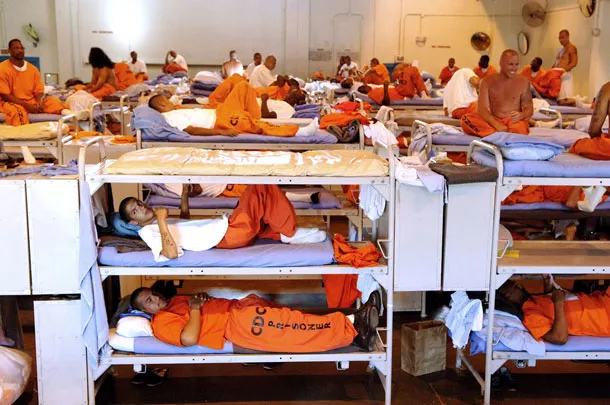
Real talk—we need to have an honest conversation about what’s really happening behind those walls. And I’m not just talking about the obvious stuff. I’m talking about how racism gets repackaged as “prison politics” and how that mess follows people home, making it damn near impossible to rejoin society after doing serious time.
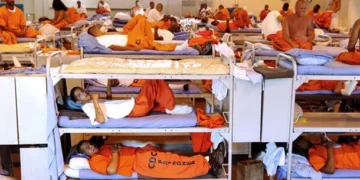
See, when folks get locked up for years—and I mean real years, not just a county bid—they enter a whole different world with its own rules. These rules ain’t written down nowhere official, but everybody inside knows them. They call it “prison politics,” and on the surface, it sounds like it’s just about respect, protection, and keeping order in a chaotic environment. But let me tell you what it really is: it’s racism with a survival handbook.
The Game Behind the Game
Prison politics operates on one fundamental principle: racial segregation. In most facilities across this country, you eat with your own, you work out with your own, you handle business with your own. African descendants with African descendants, European descendants with European descendants, Latinos with Latinos. They’ll tell you it’s about “cultural identity” or “mutual protection.” But strip away all that, and what you got? State-sanctioned segregation that would make Jim Crow blush.
Here’s what gets me: the system knows this is happening. The guards see it. The administrators document it. But instead of addressing it, they enforce it. Because guess what? Racial division keeps inmates fighting each other instead of organizing against the conditions they’re living under.
Let me break down what this looks like in practice:
| Aspect of Prison Life | Prison Politics Dictates | Society Expects |
|---|---|---|
| Social Interaction | Strict racial segregation | Diverse, integrated relationships |
| Conflict Resolution | Physical violence, racial solidarity over facts | Dialogue, mediation, legal recourse |
| Trust Building | Only within racial groups | Cross-cultural cooperation |
| Leadership Structure | Race-based hierarchies | Merit, skills, qualifications |
| Personal Identity | Race first, individual second | Individual autonomy, personal values |
Now imagine living like this for 5, 10, 15, 20 years. That ain’t just a phase you go through—that becomes your operating system.
The Psychological Rewiring
According to research from the Bureau of Justice Statistics, the average time served for serious offenses continues to increase, with many individuals spending a decade or more behind bars. During that time, something happens to your brain that most people on the outside don’t understand.
“The prison environment enforces a rigid social structure based on racial lines, and individuals who spend extensive time in this environment often undergo a process of institutional conditioning that fundamentally alters their worldview and behavioral patterns.” — Dr. Craig Haney, UC Santa Cruz psychologist and prison environment expert
When you’re locked up, violating prison politics can get you hurt or killed. So you learn. You internalize. You survive. But here’s the problem: those survival mechanisms that keep you alive inside become toxic behaviors outside.
Think about it. A cat does 12 years upstate. For 12 years, he can’t:
- Sit at a table with someone of a different race without permission
- Share resources across racial lines
- Stand up against racism without being labeled a “race traitor”
- Form genuine friendships based on shared interests rather than skin color
- Question the racial hierarchy without serious consequences
After 12 years, that ain’t prison politics anymore—that’s just politics. That’s reality. That’s how the world works, as far as his experience tells him.
The Reentry Crisis Nobody’s Addressing
Now, this brother gets released. He’s supposed to go straight from that environment to job interviews, diverse workplaces, integrated neighborhoods, and multicultural social settings. The Prison Policy Initiative reports that within three years of release, nearly two-thirds of formerly incarcerated individuals are rearrested. We blame it on lack of jobs, inadequate reentry programs, or personal failure. But we’re missing a massive piece of the puzzle.
How’s someone supposed to function in society when they’ve been conditioned—for years—to operate under a completely different set of rules? And not just any rules, but rules rooted in racial division and segregation?
I’ve seen brothers come home and struggle with the simplest interactions. Working on a diverse team at a job. Having a Caucasian supervisor give them instructions. Developing friendships across racial lines. These situations trigger the old prison politics programming, and suddenly they’re feeling like they’re violating some code, even though they’re on the outside.
The data tells part of the story:
According to the National Institute of Justice:
- 68% of released prisoners are rearrested within 3 years
- 79% are rearrested within 6 years
- 83% are rearrested within 9 years
But what the statistics don’t show is how many of these failures are connected to the inability to unlearn prison survival mechanisms—including the racial politics that governed every aspect of their incarcerated lives.
The Uncomfortable Truth
Here’s what makes this especially insidious: prisons claim they’re preparing people for reentry. They got programs, classes, job training. But none of that addresses the fundamental psychological conditioning that’s happening every single day through the enforcement of prison politics.
You can teach a man carpentry, computer skills, or anger management. But if you don’t address the fact that he’s been living in a racially segregated, violence-enforcing environment where racism is dressed up as “culture” and “protection,” you’re setting him up to fail.
And let’s be clear—this ain’t about individual racism. I’m not saying everyone who comes home from prison is a racist. What I’m saying is the system creates conditions where racist behavior is mandatory for survival, then releases people without any deprogramming and expects them to seamlessly integrate into a multicultural society.
That’s not just unrealistic—it’s intentionally setting people up to return.
What This Really Costs Us
The human cost is obvious—broken families, lost potential, communities devastated by cycles of incarceration. But there’s also an economic dimension we don’t talk about enough. The Vera Institute of Justice estimates that mass incarceration costs the U.S. $182 billion annually. A significant portion of that is the revolving door of recidivism.
If we’re serious about reducing recidivism and helping people successfully reintegrate, we gotta address prison politics head-on. That means:
- Acknowledging that enforced racial segregation in prisons is a problem, not a solution
- Creating actual deprogramming initiatives that help people unlearn prison survival mechanisms
- Training reentry workers and employers to understand the psychological impact of long-term incarceration
- Developing peer support programs where formerly incarcerated individuals can discuss and work through these challenges
- Holding prison systems accountable for perpetuating racial division
Moving Forward
Look, I get it. Prison is a dangerous environment, and people need to survive. But we can’t keep pretending that “prison politics” is just a neutral cultural phenomenon when it’s really racism rebranded for institutional convenience. And we definitely can’t keep releasing people who’ve been steeped in this for years without giving them the tools to unlearn it.
Coming home after serious time shouldn’t mean bringing prison home with you. But until we’re honest about what’s really happening—how racism disguised as prison politics is destroying people’s chances at successful reentry—we’re gonna keep seeing the same tragic outcomes.
It’s time for some real talk about what we’re doing to people in the name of incarceration and what it costs all of us when they come home carrying that weight.
That’s where I’m at with this. What about you?
For more information on prison reform and reentry challenges, visit the Sentencing Project and the Equal Justice Initiative.