


































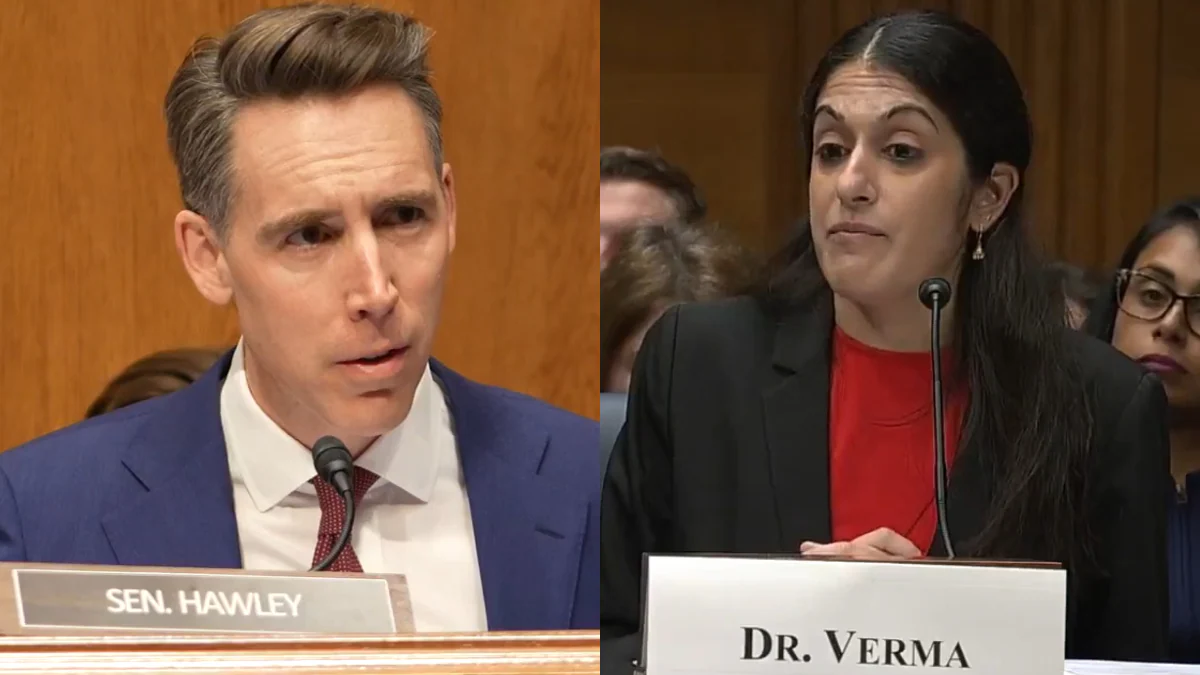
I recently watched Senator Josh Hawley ask Dr. Nisha Verma a simple question during a Senate hearing: “Can men get pregnant?” Her inability to give a straightforward answer frustrated me deeply. We have reached a point where medical professionals cannot state basic biological facts without hesitation, and frankly, it is getting ridiculous.
Let me be clear from the start: men cannot get pregnant. This is not a complicated question, despite what some would have you believe. The attempt to make it complicated represents a fundamental confusion between biological reality and social identity, and this confusion has real consequences for medical clarity, women’s rights, and honest public discourse.
The Biology Is Not Debatable
When we talk about pregnancy, we are discussing a biological process that requires specific reproductive anatomy. Pregnancy requires a uterus, ovaries, and the hormonal environment of the female reproductive system. These organs exist to produce eggs and gestate offspring. This is not opinion or ideology. This is observable, measurable biological fact.
In human reproduction, we have what biologists call anisogamy—the production of two distinct types of reproductive cells. Males produce small, motile gametes called sperm. Females produce large, stationary gametes called eggs. There is no third gamete. There is no middle ground in human reproduction. A person who becomes pregnant is, by definition, operating with female reproductive biology, regardless of how they identify socially.
The argument that “some people who identify as men can get pregnant” does not change this fundamental reality. If a person can become pregnant, they possess female reproductive anatomy. Calling them a man does not alter their biological sex any more than calling a square a circle changes its geometry.
Why Language Matters
Some people dismiss this debate as mere semantics, but language serves a purpose. Words like “man” and “woman” have historically described biological categories that everyone understood. When we decouple these terms from biological reality and make them purely subjective, we create genuine confusion in contexts where precision matters—medical care, scientific research, legal protections, and public health data.
Major medical organizations like the American College of Obstetricians and Gynecologists have adopted “gender-inclusive language,” recommending terms like “pregnant people” instead of “pregnant women.” They argue this ensures that transgender men who retain female reproductive organs are not excluded from care. While I understand the intention to be respectful, this approach sacrifices clarity and accuracy for the sake of validating a subjective identity claim.
The reality is that you can treat individual patients with respect and dignity without forcing society to redefine fundamental biological terms. A doctor can be compassionate and professional with a transgender patient without pretending that pregnancy is anything other than a female biological function.
The Erasure of Women
Here is what really troubles me about this entire debate: the unique biological reality of womanhood is being systematically erased from our language and institutions. Pregnancy is not a generic human experience—it is the distinctive experience of females. When we replace “pregnant women” with “pregnant people” or “birthing parents,” we are literally removing women from the discussion of their own biological reality.
Women have fought for decades to have their health needs recognized and funded. Maternal mortality, pregnancy complications, reproductive healthcare—these are issues that affect women specifically because of their female biology. When we obscure this reality with sanitized, gender-neutral language, we make it harder to advocate for women’s health and to collect meaningful data about female-specific conditions.
This is not about denying anyone’s dignity or humanity. This is about maintaining honest language that describes biological reality. Gender-critical feminists and conservatives may disagree on many things, but they have found common ground here: pregnancy is a sex-based reality, and refusing to acknowledge this plainly is a denial of truth.
The “It’s Complicated” Dodge
When medical professionals like Dr. Verma say this question is “complicated,” what they really mean is they are caught between biological fact and ideological pressure. The science is not complicated. Human reproduction is binary and sex-based. The complication comes from trying to reconcile objective biological categories with subjective identity claims.
Consider this parallel: humans have ten fingers. The fact that some people are born with more or fewer does not make the statement “humans have ten fingers” false or “complicated.” It remains a true categorical statement about human anatomy, and we all understand that exceptions exist. Similarly, the existence of transgender individuals or rare intersex conditions does not make “men cannot get pregnant” a complicated question. It remains categorically true that male biology does not include the capacity for pregnancy.
The push to treat rare exceptions as invalidating general biological rules is not scientific rigor—it is rhetorical maneuvering.
Real-World Consequences
This is not just an academic debate. In recent years, we have seen significant legislative action to codify biological definitions into law precisely because the confusion has created real problems. The Defining Male and Female Act introduced at the federal level seeks to establish that sex is an immutable biological classification based on reproductive function, not subjective identity.
As of 2026, approximately seventeen states have passed laws or executive orders that use biological sex as the sole legal definition for men and women in contexts like sports, prisons, and restrooms. These states recognized that when we allow subjective identity to override objective biology, we create situations that compromise fairness, safety, and the rights of women and girls.
The Trump administration’s January 2025 executive order, “Defending Women From Gender Ideology Extremism,” directed federal agencies to return to biological definitions, explicitly rejecting the notion that men can get pregnant. Whatever one thinks of the administration’s other policies, this particular action restores clarity and honesty to federal health communications.
Moving Forward With Honesty
I understand that gender identity is important to some people, and I respect that individuals should be treated with dignity regardless of how they identify. But respect does not require us to deny reality or to restructure our entire language around subjective feelings.
We need to return to a framework where biological sex and social identity are recognized as distinct concepts. Medical forms can include both “biological sex” for clinical purposes and “gender identity” for social purposes without conflating the two. This allows for both accuracy and respect.
But we cannot continue down a path where medical professionals cannot answer simple questions about human biology without equivocating. We cannot allow ideology to override scientific fact in medical education and practice. And we cannot permit the erasure of women from discussions of their own biological experiences.
The question “Can men get pregnant?” has a clear, unambiguous answer: No. Men are adult human males, and males do not possess the biological capacity to gestate offspring. This is not hateful. This is not bigotry. This is simply the truth, and we need to be able to say it plainly.
It is time we stopped playing word games with biology and returned to honest, clear language that serves everyone better—including those who identify as transgender. Because ultimately, good medicine and good policy both depend on our willingness to describe reality as it actually is, not as we might wish it to be.