





































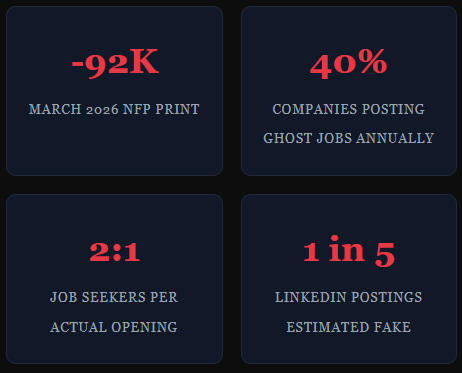
Friday morning I was sitting with my Starbuck’s refresher watching the numbers roll in on the Non-Farm Payrolls report, and son — I had to put the cup down. Negative 92,000 jobs. Not a slowdown. Not a miss. A negative print. The United States economy shed nearly a hundred thousand jobs in a single month, and I want you to really sit with that for a second before we move on.
Now, I know some of y’all are going to say, “Van, one report doesn’t make a trend.” And you’re right — technically. But when you line that number up against everything else we’ve been watching in the labor market, this isn’t a blip. This is confirmation. And it connects directly to something I watched on YouTube this week — a video titled “They Are Not Hiring. It Is A TRAP” — that cracked open something most people don’t want to admit about the so-called job market we’re living in.
“The job market is not just slow. A significant portion of what looks like the job market isn’t a market at all — it’s theater.”
Let’s Talk About the NFP Report First
The Bureau of Labor Statistics Non-Farm Payrolls report is the single most watched labor market indicator in the world. When it goes negative, it means the economy is actively destroying more jobs than it creates. A -92,000 reading, following several months of already-weakening data, is not a good look. For context, the BLS had already noted that job openings by the end of 2025 were at their lowest levels in five years.
Non-Farm Payroll Monthly Change — Recent Trend (Thousands of Jobs)
What makes this worse — and this is what the video laid bare — is that many of the “job openings” we’ve been counting in the data aren’t real jobs. They are what the industry quietly calls ghost listings, or phantom jobs. When the headline numbers already look grim, and then you factor in that a meaningful share of the postings driving those “opening” counts are fabricated, the labor market is in a far deeper hole than the official narrative suggests.
The Ghost Job Epidemic: They’re Fronting on You
The video I watched breaks down a phenomenon that has quietly become systemic. Companies — well-known, “reputable” ones — are posting jobs that they have absolutely no intention of filling. And they’re doing it for reasons that range from mildly cynical to outright predatory.
Some are building what HR departments euphemistically call a “talent pipeline” — essentially collecting your resume for a rainy day with no intention of calling you. According to data cited in the video, 60% of companies that post these phantom jobs hold onto resumes with zero plans to hire. They’re not building a pipeline. They’re farming your data and wasting your time.
Some are posting jobs to look like they’re thriving — projecting growth and expansion to customers, investors, and their own employees. Word is bond: 70% of companies that posted fake job listings said it boosted their revenue perception. That’s a con game dressed up in a LinkedIn banner.
And then there’s the darkest version of this — what the video calls the “Great Interview Heist.” Companies that post fake roles, run candidates through multiple rounds of interviews, extract your best strategic ideas, your pitches, your creative work samples — and then ghost you, only for your ideas to appear on their website weeks later. No credit. No compensation. Dead serious.
Ghost Job Prevalence by Industry (% of Job Ads Estimated Fake)
By the time you realize what happened, they’ve already posted the same fake listing to extract ideas from the next candidate. Research from workforce intelligence firm Revelio Labs showed that around 2020, roughly eight in ten jobs posted online led to an actual hire. That ratio has since collapsed to four in ten. Let that sink in. You now have less than a coin-flip’s chance that the job you’re applying for is real.
Share of Online Job Postings That Resulted in an Actual Hire (%) Why don’t companies face consequences? Because there are none. No federal law prohibits posting a fake job listing. The FTC has no enforcement mechanism for phantom job postings. Companies operate in a regulatory vacuum, and job seekers have no recourse for the hours, ideas, or dignity lost in the process.
We Are Becoming a Freelance Society — Whether We’re Ready or Not
Here’s where I connect the two threads, because this is the part that keeps me up at night. If formal employment is quietly hollowing out — and the evidence strongly suggests it is — then we are, by default, being pushed toward a freelance, gig-based, independent contractor economy. The Upwork Future Workforce Report and data from MBO Partners’ State of Independence study both show that the independent workforce has grown significantly over the past five years. This isn’t just Uber drivers and DoorDash riders — it’s writers, designers, analysts, consultants, engineers, and strategists operating outside the traditional employer-employee relationship.
On the strength, I think this shift has been underway for a while. COVID accelerated it. The explosion of remote work normalized it. And now, as companies shed jobs while simultaneously filling their pipelines with phantom listings, the workforce is being quietly redirected toward a model where you are your own business — whether you signed up for that or not.
For people with marketable, portable skills — the ability to code, write, design, consult, trade, or build — this transition, while uncomfortable, is survivable. Some of us are already living in it and doing okay. The freelance infrastructure exists: Upwork, Toptal, Fiverr, direct client relationships, personal brands built through content. It’s not easy, but there’s a road.
“But what about everyone else? What about the workers who spent twenty years in a sector that required showing up, following instructions, and trusting that the system would hold up its end of the deal?”
The People Who Get Left Behind
This is the part of the conversation that I find genuinely troubling, and I don’t say that lightly. We talk about the freelance economy like it’s a meritocracy — like if you just hustle hard enough and build the right skills, you’ll find your footing. And to a degree, that’s true. But that framing glosses over a massive structural problem.
Freelancing requires a specific kind of capital that not everyone has. You need digital literacy. You need self-marketing ability. You need to be able to navigate contracts, invoicing, self-employment taxes, client acquisition, and the psychological weight of income instability. You need, in many cases, a financial cushion to weather the gaps between gigs. Federal Reserve data consistently shows that nearly 40% of American adults cannot cover an unexpected $400 expense. These are not people who can absorb the learning curve of becoming a freelancer while their lights are threatening to go out.
Think about the construction worker, the warehouse associate, the customer service rep, the retail floor manager. The video points out that construction has the highest ghost-job rate of any industry — 38% of its listings are fake. The people competing for those jobs are not, on the whole, people with LinkedIn personal brands and Upwork profiles. When those jobs evaporate — both the real ones and the illusions of them — where do these folks go?
No cap: if we don’t take this question seriously, we are heading toward a social stability crisis. A -92,000 NFP print is not just an economic number. It is a human number. It represents nearly a hundred thousand households that lost income, lost structure, lost a sense of forward momentum. And if the jobs that replace them are phantom listings designed to extract free labor or pad a company’s appearance of growth, then we are not rebuilding — we are deceiving ourselves about what recovery even means.
Chaos Is the Default Destination Without Systemic Change
I want to be precise here, because I’m not interested in doom-scrolling dressed up as analysis. What I’m saying is that the trajectory we’re on — a labor market that produces fewer real jobs, increasingly rewards only the digitally skilled, and tolerates widespread corporate deception in hiring — has a predictable destination. And that destination is social and economic instability at a scale we should take seriously.
What would meaningful systemic change look like? A few things come to mind immediately. First, we need regulatory frameworks that address ghost job listings — at minimum, transparency requirements that force companies to report hire rates for posted positions. Second, we need serious investment in workforce reskilling that goes beyond the corporate-sponsored LinkedIn Learning model. The Workforce Innovation and Opportunity Act exists but is chronically underfunded. Third, we need an honest national conversation about whether our social safety net — designed for a 20th-century employment model — is remotely adequate for a gig economy reality.
And for those of us who are investors and market observers, the -92,000 NFP print is a signal worth watching closely. Weak labor data, combined with a structurally hollowing job market and growing consumer financial fragility, creates a risk environment that doesn’t resolve itself quietly. The Federal Reserve will face pressure. Monetary policy will be complicated by the fact that this isn’t your classic cyclical downturn — it has structural components that rate cuts alone won’t fix.
“You can’t cut your way to a job market that respects workers. At some point, the rules of the game have to change.”
Where Do We Go From Here
If you’re in the job market right now, the video’s advice is sound: look for the red flags. Postings that have been up for 30-plus days. Companies with no hire rate history. “Interviews” that feel like free consulting sessions. And do your due diligence — Glassdoor, Reddit’s r/jobs and r/cscareerquestions, and LinkedIn reviews can surface patterns that individual applicants can’t see on their own.
If you have any capacity to build freelance skills — do it now, while you have time. The market is not waiting for anyone to feel ready. Copywriting, data analysis, financial modeling, social media management, bookkeeping, coding, video editing — these are skills with genuine independent contractor demand, and the infrastructure to monetize them exists today.
But at the macro level, I want to be honest with you: individual hustle is not sufficient at scale. When a society produces millions of people who cannot navigate an increasingly hostile labor market through no fault of their own, and when the institutions designed to buffer that hardship are inadequate, individual preparation only goes so far. The -92,000 is a number. But behind every one of those jobs is a person. And we should govern ourselves accordingly.
Stay sharp out there. The numbers don’t lie, even when the job listings do.
— Van
The views expressed in this article are the author’s own and do not constitute financial or legal advice.
Data sourced from BLS, Revelio Labs, Upwork, MBO Partners, and The Infographics Show.