































Last Updated on November 14, 2026 by Van Phillips
Most of us never sit down and write an investment plan. We buy things one at a time, for one reason or another, and years later the accounts are full of positions nobody can explain.
This month I went through mine. Over four days I went account by account and asked one question about every position: why is this here? If I didn’t have a good answer, it went.
Here’s what I found, what I changed, and the rules I wrote so I don’t end up back in the same mess.
The audit wasn’t pretty
My Income account had 26 holdings. For an account that size, that isn’t diversification. It’s clutter. Several were foreign stocks like BBD, GFI, AEG, and UGP. Some overlapped with each other. And a lot of the income they paid got taxed at my full rate.
My Growth account was worse. Speculative stocks, a put option, and margin turned on. None of it matched what that account is supposed to do, which is grow my money over a long time without me watching it.
My emergency fund was fine. It just wasn’t as efficient as it could be. I’ll get to that.
I changed what I’m asking my income money to do
For a long time, the goal for my Income portfolio was “as much cash flow as possible.” That goal pulls you toward the highest yields, and the highest yields usually come with more risk, more tax, or payouts that don’t grow.
So I changed the goal to sustainable, after-tax income that grows faster than inflation. The long-term target is simple. One day, that income should cover the cost of living in New York City.
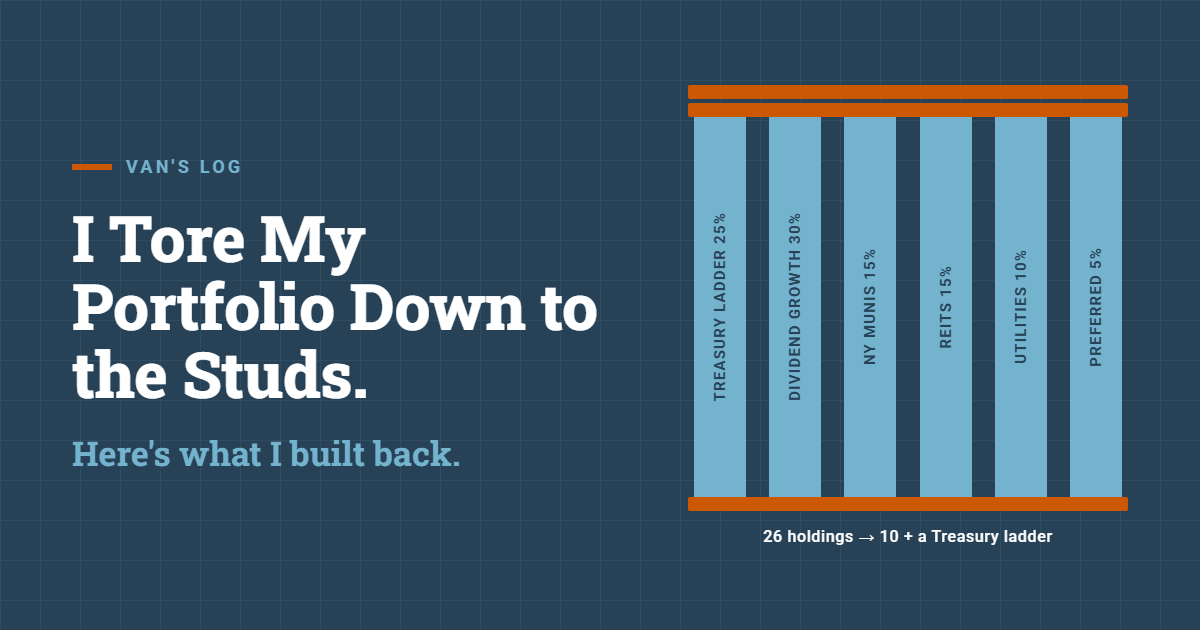
Once the goal changed, the holdings had to change too. Twenty-six positions became ten, plus a Treasury ladder. The account is now split into sleeves with a target for each. The Treasury ladder is 25%. Dividend growth, through SCHD, is 30%. New York municipal bonds, through NYF, are 15%. REITs are 15%, utilities and infrastructure are 10%, and preferred stock is 5%.
Every sleeve has a job. The ladder is the steady base. SCHD is there for dividends that grow over time. The muni fund pays income that federal, state, and city tax don’t touch. The REITs and utilities own real assets that throw off cash, and the preferred adds a little extra yield on top.
4.5% is the new bar
What moved me most was looking at where rates are right now.
The Fed raised rates in September and held in October. As of mid-November, the federal funds rate sits at 3.75% to 4.00%. Inflation was running 3.7% a year in the September report, with energy doing most of the pushing (BLS CPI release). Short-term Treasuries are paying roughly 4.4% to 4.9%, depending on how far out you go.
Now, think about what that means. Government debt, about as safe as it gets, is paying around four and a half to five percent. Any riskier income investment has to beat that to earn a spot in my account. A lot of what I used to own couldn’t clear that bar once I adjusted for risk and taxes.
That’s why I built the ladder. It has six rungs, coming due about every six months from May 2027 out to November 2029. The average yield to maturity came out to 4.74%. And because it’s Treasury interest, New York State and New York City can’t tax it.
I set rules for buying the rungs too. Take the highest yield in the maturity window. Keep the price between 98 and 101. Compare offers on the same rung so I can spot a markup. When a rung matures, the money goes into a new three-year note at the next review.
The yield you see isn’t the yield you keep
This one surprised me, and it might surprise you too.
My emergency fund was sitting in a Schwab money market fund with a solid 7-day yield. But I live in New York City, so interest can get taxed three times: federal, state, and city. I lined up the options and asked what I’d actually keep after taxes, using Schwab’s posted yields from November 10.
| Fund | 7-day yield | Kept after tax |
|---|---|---|
| SNSXX (Treasury money fund) | 3.67% | 2.79% |
| SWVXX (what I had) | 3.75% | 2.49% |
| SNOXX | 3.63% | 2.41% |
| SWYXX (NY muni) | 2.11% | 2.11% |
The fund with the highest headline yield came in second to last on what actually lands in my pocket. I switched to SNSXX, the Treasury fund, because most of its income is exempt from state and city tax.
There’s one catch. You have to claim that exemption. Every year the fund publishes what percentage of its income came from U.S. government securities, and you subtract that portion on your New York return. Skip that step and the advantage is gone.
The emergency fund now covers about 8.7 months of my spending. With that much set aside, I don’t have to sell anything else when an expense comes up.
Growth money should be boring
I closed the speculative stocks. I closed the put. I turned off margin and futures in that account. Then I made it as plain as I could: 75% SCHB, the U.S. total market, and 25% SCHF, international developed markets.
That’s it. Two low-cost index funds. Every new dollar I save goes here until I’m about five years from needing the income.
I trade futures, and that has its own money and its own rules. It doesn’t belong in the account that’s supposed to build long-term wealth.
Go look at the account you never look at
My union annuity is my biggest account, and I hardly ever thought about it. Contributions came out of my employer’s pocket and that was the end of it.
When I finally dug in, I found I was paying for funds I didn’t need. One inflation-protected bond fund charged 0.92% a year. The Vanguard index funds in the same lineup cost three to five hundredths of a percent. I rebalanced into mostly Vanguard index funds, with a small slice in bonds and stable value. That brought the blended cost from about 0.14% down to about 0.10%, and I set it to rebalance automatically.
Four hundredths of a percent sounds like nothing. Over decades, on your biggest account, it’s real money.
If you have a 401(k), a 403(b), or a union annuity, open it this week. Look at the expense ratio on every fund you own.
The pension is the foundation
This is the part that made the whole plan come together.
My union pension pays an unreduced benefit at 62 if I reach 25 years of credited service. Retire before 65 without that, and it gets cut 3% for every year early. So the plan is to leave work at 62, let the pension and the portfolio carry me, and hold off on Social Security until somewhere between 67 and 70 so that check comes out bigger.
The biggest risk to the plan isn’t the stock market. It’s losing covered hours before I hit 25 years. Everything else I can adjust. That one I have to protect.
Reading my pension statement turned up some housekeeping too. It was still going to an old address, and one field showed my vesting service as zero, which doesn’t match my credited years. I’m writing to the fund to fix both and to ask for a written estimate at 62. If you have a pension, read your statement line by line. Mistakes happen, and nobody is going to catch them for you.
The rules I wrote so I leave it alone
A plan only works if you stop tinkering with it, so I wrote rules.
I only rebalance when something drifts more than 5 percentage points from its target. The economy only gets to change the bond side, meaning how long the ladder runs and how much sits in Treasuries, munis, or cash. Headlines don’t get to touch my stock allocation. That split only changes when my life changes: my hours, my pension estimate, my goal, or getting within five years of retirement.
When money comes in, I put new cash to work first. Then I rebalance inside the annuity, where it’s tax-free. Selling in a taxable account comes last.
And I review it every quarter, on the second Friday of December, March, June, and September. December is the big one, with tax-loss harvesting and an updated retirement projection.
I still have open questions on the pension math, and I still need to pull my Social Security estimates. But every account now has a job, and I wrote down what that job is. If you’ve never done that with your own accounts, start with the one you look at least.
This is my personal plan and my own thinking, not financial, legal, or tax advice. Talk to a professional about your own situation.