































Last Updated on September 5, 2026 by Van Phillips
My son is thirteen. He’s got years before he has to make any real decisions about what he does with his life. But I’ll tell you something — I’d rather he walk into that decision with his eyes open than stumble into it the way a lot of us did, chasing something because it sounded good, or because everybody else was doing it, or because nobody ever sat us down and showed us the whole board.
I’ve been sitting with the BLS Employment Projections data for a couple of days now, breaking it down for this blog. And somewhere in the middle, it hit me — this isn’t just content for grown folks managing a career pivot. This is exactly the kind of thing a thirteen-year-old needs in his hands before he’s fifteen and everybody’s asking him what he wants to be.
I don’t want my son picking a path off vibes. I want him picking it off information — and I want that information sitting right next to what actually makes him come alive.
So this one’s for him. And honestly, it’s for every young person out there who’s about to make one of the biggest financial decisions of their life without anybody handing them the receipts first.
The Four Things I’m Teaching Him to Look At
Every time he brings up something he’s interested in — and at thirteen, that list changes every few months — I want him running it through four filters. Not to kill his dreams. To sharpen them.
1. Demand — Is This Field Actually Growing?
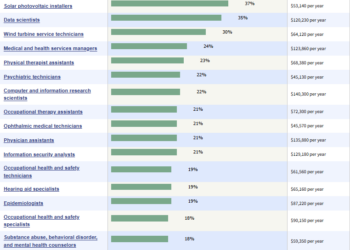
This is the easiest one to check and the one most people skip. BLS publishes exactly how fast every occupation in the country is expected to grow over the next decade. Growth doesn’t guarantee anything, but shrinkage should at least make you ask harder questions.
| Occupation | Projected Growth 2025–35 |
|---|---|
| Nurse practitioners | +41.0% |
| Data scientists | +34.6% |
| Solar photovoltaic installers | +36.5% |
| Software developers | +10.2% |
| Registered nurses | +5.6% |
| Office clerks, general | -6.0% |
| Data entry keyers | -25.5% |
That last row is the one I want him to really sit with. It’s not that data entry work is a bad job today. It’s that the door is closing on it, and I don’t want him building his whole future behind a door that’s already swinging shut.
2. Supply — How Many Actual Openings Are There Each Year?
Here’s the part most career conversations with young people completely skip, and it’s the one his mom and I care about most. A job can have a huge growth percentage and still be a tiny door. Wind turbine service technicians are growing at 29.5% — sounds incredible — but that only works out to about 1,500 new openings a year, nationally. Compare that to registered nurses, growing much slower at 5.6%, but opening up 180,800 new positions every single year.
| Occupation | Growth % | Annual Openings (nationwide) |
|---|---|---|
| Registered nurses | +5.6% | 180,800 |
| Software developers | +10.2% | 95,300 |
| Electricians | +9.2% | 72,700 |
| Nurse practitioners | +41.0% | 29,400 |
| Data scientists | +34.6% | 24,800 |
| Solar photovoltaic installers | +36.5% | 4,200 |
| Wind turbine service technicians | +29.5% | 1,500 |
| Computer and information research scientists | +21.8% | 2,900 |
A flashy growth percentage on a tiny field is still a tiny field. I want my son chasing a door that’s actually wide enough to walk through.
That doesn’t mean skip the small, fast-growing niche fields — somebody’s got to install those solar panels, and if it’s something he genuinely loves, a small door is still a door. It just means he needs to know the size of the room he’s walking into, not just the speed at which it’s growing.
3. Education Path — What Does It Actually Cost to Get In?
This is where I want to break a myth for him early: the highest-paying, fastest-growing jobs don’t all require the same four-year, six-figure-debt pipeline. Look at the spread:
| Occupation | Typical Education Needed | Median Pay | Growth |
|---|---|---|---|
| Electricians | High school diploma + apprenticeship | $63,190 | +9.2% |
| Solar photovoltaic installers | High school diploma + on-the-job training | $53,140 | +36.5% |
| Wind turbine service technicians | Postsecondary nondegree award | $64,120 | +29.5% |
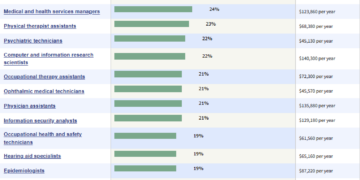
| Physical therapist assistants | Associate’s degree | $68,380 | +23.0% |
| Registered nurses | Bachelor’s degree | $97,550 | +5.6% |
| Software developers | Bachelor’s degree | $135,980 | +10.2% |
| Data scientists | Bachelor’s degree | $120,230 | +34.6% |
| Nurse practitioners | Master’s degree | $132,300 | +41.0% |
| Computer & information research scientists | Master’s degree | $140,300 | +21.8% |
An electrician with a high school diploma and an apprenticeship — no college debt at all — is out-earning a lot of bachelor’s-degree holders, and doing it in a field growing faster than average. I want my son to know that before he’s sixteen and everybody around him is only talking about which college to apply to. College might be exactly right for him. But it should be a choice he makes with the whole board in front of him, not the only board anybody showed him.
4. Pay vs. Cost of Living — The Number Nobody Talks About
This is the filter I care about most, and it’s the one that gets skipped constantly. A salary means nothing floating in space. It means everything once you put it next to rent.
$60,000 in a small city where rent runs $900 a month is a completely different life than $60,000 in a place where a one-bedroom runs $2,800. Same number on paper. Not the same life.
I want him running any career he’s considering through a simple gut-check math problem before he ever commits to it: take the median pay for that job, take the cost of a decent one-bedroom apartment wherever he’s actually planning to live, and see if the math survives contact with reality. Not “can I technically afford rent,” but “does this job leave me room to build a life — save, travel, eventually support a family, breathe.” If a career’s median pay barely clears rent in the city he wants to live in, that’s a real conversation to have before four years of tuition, not after.
Where Passion Fits Into All of This
Now, here’s the part I won’t compromise on, and it’s the part that keeps this from turning into a cold spreadsheet exercise: none of this matters if he hates what he’s doing every single day.
I’ve watched people chase the “smart” career on paper and burn out miserable inside of five years. Data and passion aren’t opposites — they’re supposed to work together. The whole point of showing him the demand, the supply, the education path, and the real cost of living isn’t to override what he loves. It’s to help him find where what he loves overlaps with a door that’s actually open.
A career you’re not passionate about will drain you slow, even if it pays well. A passion with no viable path will drain you fast, no matter how much you love it. I want my son standing in the overlap of both.
If he loves working with his hands and building things, I want him to know electricians and solar installers are growing fields with real pay and no crushing debt attached. If he loves puzzles and numbers, I want him to see data science sitting at 34.6% growth with strong pay. If he’s drawn to caring for people, nursing and the whole healthcare pipeline is where this entire economy is pointed for the next decade. The framework doesn’t tell him what to love. It just tells him which of the things he might love actually have room for him to grow inside them.
My Actual Ask of Him
I’m not handing my son a spreadsheet and telling him to pick a lane at thirteen. That’s not the point, and it wouldn’t work anyway — kids change, and they should. What I am doing is making sure that by the time he’s old enough for this decision to matter, checking the demand, checking the openings, checking the education cost, and checking the pay against the cost of living is just as normal to him as checking the reviews before he buys something off Amazon.
Every young person deserves to walk into their first real career decision with this information already in their hands — not discovering it five years and one useless degree later. That’s the head start I want for him. Not a shortcut. Just a clear view of the board before he makes his move.
Full occupational data, including growth rates, education requirements, and annual openings, is searchable at the BLS Occupational Outlook Handbook.